MELIORA: Mars Exploration Layered Infrastructure for Operations, Research, and Advancement

MELIORA (Oct 2025 – Jun 2026)
Mars Exploration Layered Infrastructure for Operations, Research, and Advancement
Second Place Overall, and Best in Theme for Communication, Position, Navigation and Timing Architectures for Mars Surface Operations, at NASA's 2026 RASC-AL Forum, the culminating event of the NASA Revolutionary Aerospace Systems Concepts - Academic Linkage competition.
A planetary communications network works when no one on the surface has to wonder whether it is there. MELIORA is designed to recede into the background that way, and the question the team set itself was which constellation makes that possible. Rather than fix a geometry and verify it, they searched the geometry itself, scoring 5,764 candidate constellations down through 169, then 12, to 59 architectures on the cost-and-performance frontier, and finally to one.
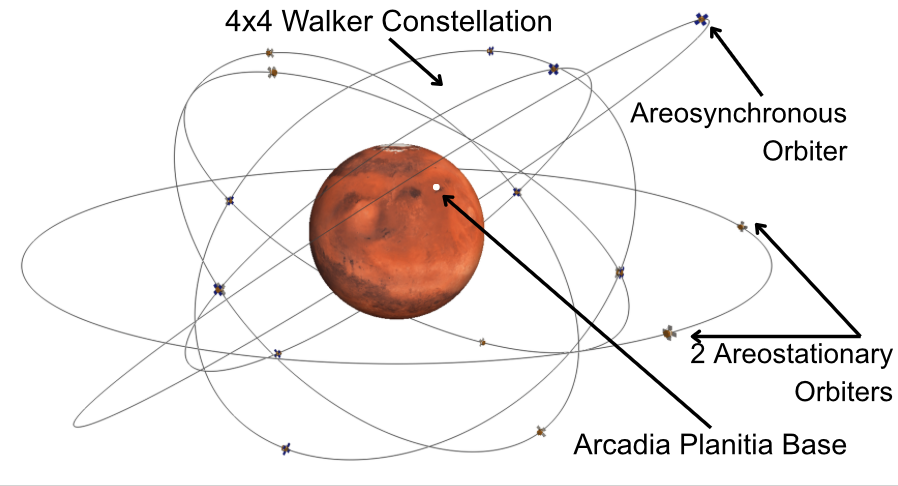
Three forces work against a Mars network. Solar conjunction, the weeks when the Sun sits between the planets, blacks out a direct link. A single relay is a single point of failure. And precise positioning usually asks the user to haul heavy hardware. The selected architecture answers all three. Two areostationary hubs and an inclined areosynchronous orbiter anchor coverage, a Walker constellation augments it, and four relay nodes parked at the gravitationally stable Sun-Mars and Sun-Earth L4 and L5 points hold the link open straight through conjunction. The Mars-orbit segment grows in phases from 3 satellites to 19; with the four Lagrange relays the full constellation reaches 23.
Most of the complexity sits in orbit so the surface stays light. A Ka-band network and an optical trunkline return at least 100 megabits per second to Earth, and a chip-scale atomic clock, a timekeeper the size of a matchbox, lets a portable terminal fix its position to 12 meters half the time and within 19 meters in 95 percent of cases. The team validated throughput, accuracy, and resilience with link-budget analysis, weighted-least-squares covariance prediction, and Monte Carlo stress tests under dust storms and subsystem failures, at an estimated $4.98 billion across twelve years of operations.
The competition framed the problem around Mars, but MELIORA proposes to prove the design at the Moon first, in lunar geometry, using a polar Walker constellation and relay nodes in near-rectilinear halo orbit. That sequence matches NASA's strategy of maturing technology on the Moon before extending it to Mars, and it gives the architecture a path to flight years before the first Mars element launches.
Leadership & Team
MELIORA was led by Clayton Lieberman and Katiyayni Balachandran (System Design and Management), Ekaterina Tiukhtikova (Aeronautics and Astronautics, and Electrical Engineering and Computer Science), and Celvi Lisy (Aeronautics and Astronautics). The team included Thomas Harrington, Zachary T. Barnes, and Asael Acosta, with Lanie McKinney as student co-advisor.
I supported this team on a day-to-day basis as their sponsor, mentor and lead advisor. Joining me were faculty advisors Prof. Kerri Cahoy, Prof. Jeffrey Hoffman and Prof. Olivier de Weck.
Project materials
Technical paper · Technical poster · Chart deck · Forum presentation