ECLIPSE: Exploration-Class Lunar Integrated Power SystEm
ECLIPSE (Oct 2025 – Jun 2026)
Exploration-Class Lunar Integrated Power SystEm
First Place Overall, and Best in Theme for Lunar Surface Power and Power Management and Distribution Architectures, at NASA's 2026 RASC-AL Forum, the culminating event of the NASA Revolutionary Aerospace Systems Concepts - Academic Linkage competition.
Most lunar power studies begin by choosing a generation source and sizing it to a mass or peak-watt target. ECLIPSE begins from a different number: the fraction of the year the grid is allowed to go dark. The team set it at 99.995 percent availability, the figure a critical terrestrial data center is held to, which leaves fewer than 27 minutes of outage in a worst-case year. On the Moon that target is unforgiving. A lapse in life-support power threatens a crew within hours, and the south-polar night runs roughly eighteen days at a stretch, far longer than any battery alone can bridge.
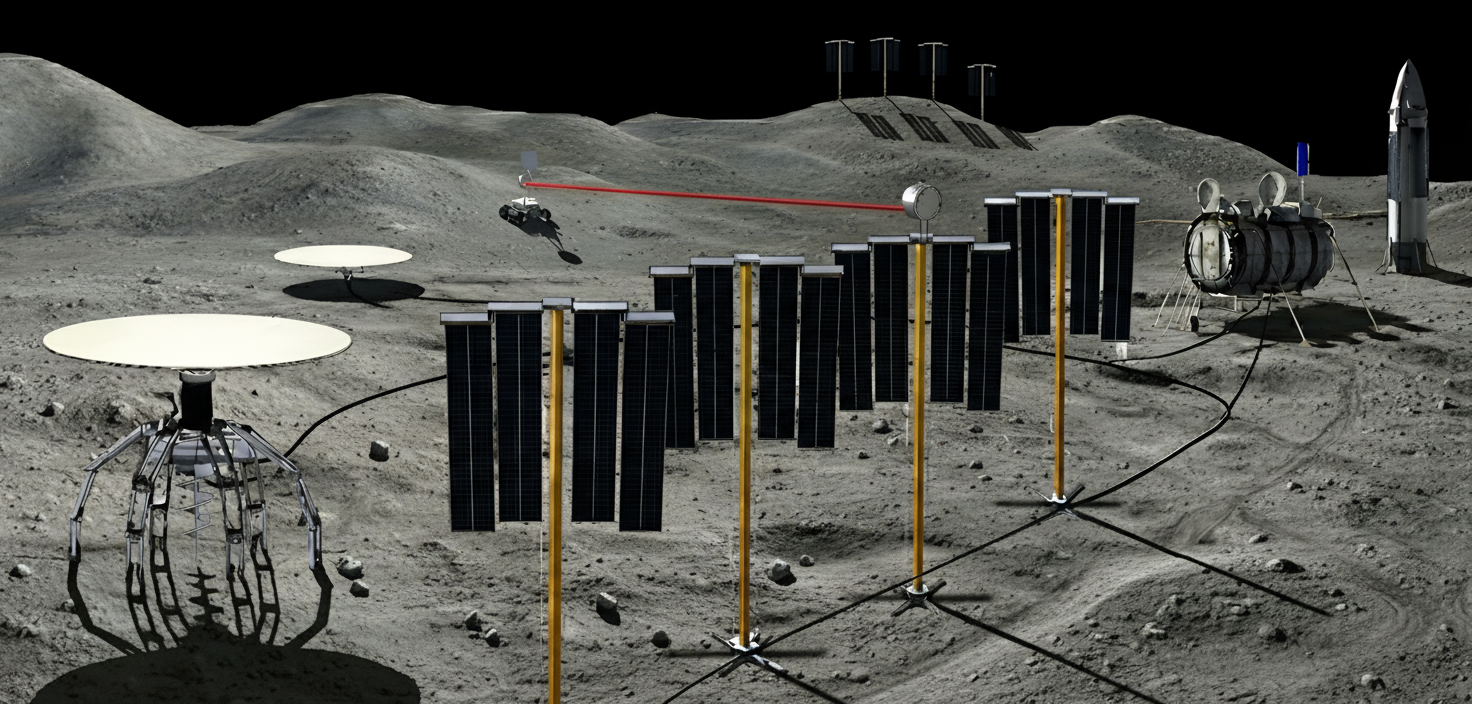
The design meets the target by pairing two sources that fail for unrelated reasons. Banks of 20-meter solar masts stand in the sunlit highlands near the south pole and feed the grid whenever the sun is up. For the dark stretch, a pair of buried microreactors takes over. The team designed the reactor itself: CARROT, the Compact Autonomous Regolith-shielded Reactor Operating for Ten years, a 20-kilowatt unit set 1.3 meters into the regolith so its radiation keep-out zone shrinks from kilometers to meters and crews can work beside it. A reliability trade across reactor types placed a high-performance Stirling conversion ahead of the Brayton variants on mean time between failures, and the system-mass-against-reliability frontier fixed the reference design.
Two kinds of generator are necessary but not sufficient. Availability at that level is a property of the whole grid, and the team searched for it as one. Candidate base architectures each combined a generation mix with its own storage, power management, and distribution, and each was judged on the reliability it delivered against the mass it cost; most ways to add uptime also added tonnage, and the chosen design is the one that reaches the target without the mass it does not need. Power management and distribution does as much of the work as the generators: it sizes storage to bridge the gap between sun and reactor, reroutes power around a failed string, and keeps a single fault from reaching the crew.
Waste heat is not discarded. Nuclear cogeneration feeds a thermal grid alongside the electrical one, and laser-equipped Frontier Power rovers beam up to 10 kilowatts to sites no cable reaches, from a shadowed crater to a new outpost before its own grid exists. The reference architecture, sited at Shoemaker Rim F, delivers an initial 120 kilowatts at an estimated $12.7 billion and scales from a first crew of six toward industrial demand without an interruption the inhabitants would notice. The CARROT reactor, developed independently, converged on the same speed-to-deployment logic as NASA's SR-1 design for the 2028 Mars mission, and the grid that holds a six-person camp through the night is the one a lunar industry would draw on a decade later.
Leadership & Team
ECLIPSE was led by Taylor Hampson (Nuclear Science and Engineering) and Patrick Riley (Aeronautics and Astronautics). The reactor team was Liliana Arias, Sydney Menne, Julian Rocher, and Pavel Shilenko. Power management and distribution was Evrard Constant, Mary Foxen, Janhavi Joglekar, and Asma Patel. Solar and architecture was Sreeja Akula, Zachary Dawson, Ian Jimenez, Yohan Lim, and CJ Taglienti. Yana Charoenboonvivat, Lanie McKinney, Palak Patel, and Sully Marigliano-Crevecoeur served as student co-advisors.
I supported this team on a day-to-day basis as their sponsor, mentor and lead advisor. Joining me were faculty advisors Prof. Olivier de Weck, Prof. Jeffrey Hoffman and Prof. Koroush Shirvan.
Project materials
Technical paper · Technical poster · Chart deck · Forum presentation