CERBERUZ: Composites for Extraterrestrial Recycling By Engineering the Reuse and Upcycling of Zotek

Overview
CERBERUZ delivers a fully integrated, end-to-end recycling and manufacturing pipeline for some of the Moon’s most challenging waste streams: thermoset foams and mixed thermoplastics. CERBERUZ stands for ‘Composites for Extraterrestrial Recycling By Engineering the Reuse and Upcycling of Zotek’. The project was one of the 13 Phase I winners out of 1,200 submissions to the 2025 NASA LunaRecycle Centennial Challenge. One of the hardest materials to recycle is ZOTEK F30 foam. Rather than water-intensive or chemical depolymerization processes, CERBERUZ relies on mechanical and plasma-based methods that run solely on power, produce zero secondary contaminants, and leverage the lunar vacuum and regolith for on-demand manufacturing.
In the Phase 1 reference architecture, the final outputs were regolith-derived molds, composite 3D-printer filament, injection-molded parts, and cast aluminum components. For Phase 2, the concept was purposefully scaled down and descoped into a terrestrial demonstration built around two of its most novel systems, CHARON for preprocessing and PERSEPHONE for composite injection molding and filament extrusion, with the cryogenic step engineered out along the way.
First Prize, NASA LunaRecycle Challenge
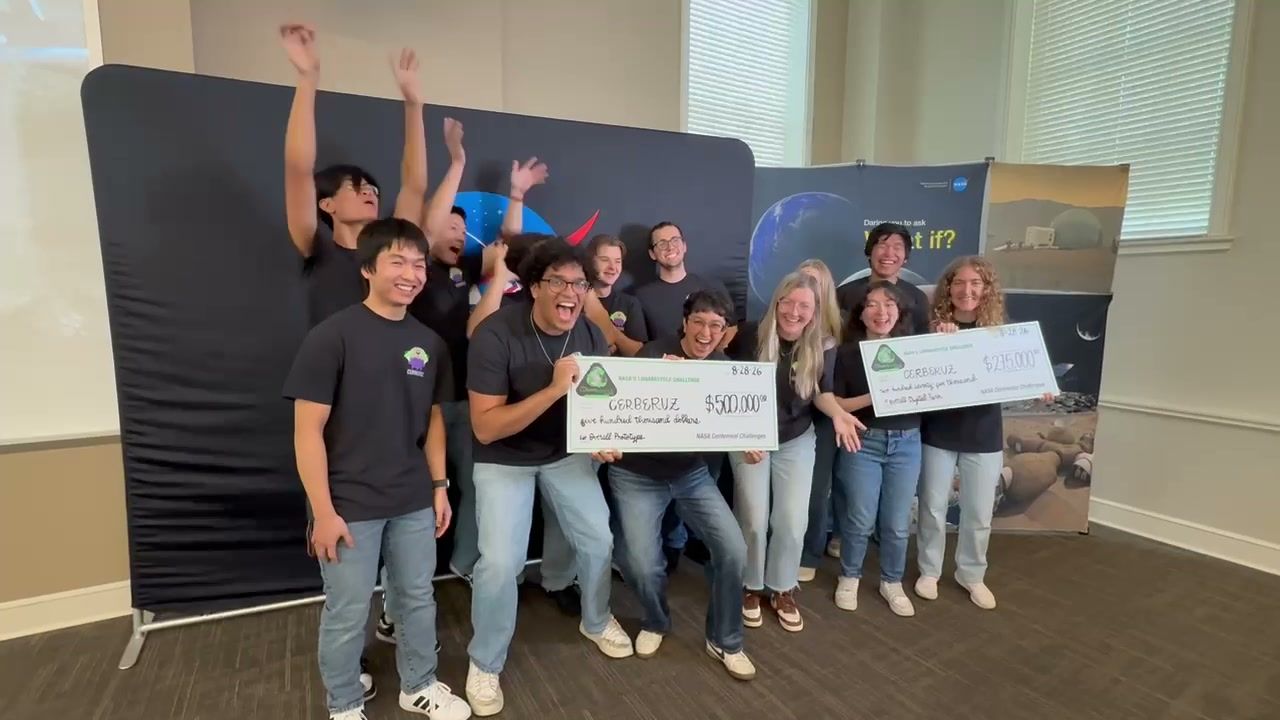
On August 28, 2026, NASA awarded CERBERUZ first prize in the LunaRecycle Challenge, closing out a two-year, $3 million competition that drew more than 1,200 registrations, a record in the twenty-year history of the agency's Centennial Challenges program. Fourteen finalist teams demonstrated their systems live over five days at the University of Alabama's Lee J. Styslinger Jr. College of Engineering in Tuscaloosa. CERBERUZ placed first overall in the prototype development track and first overall in the digital twin track, the only team to take first in both.
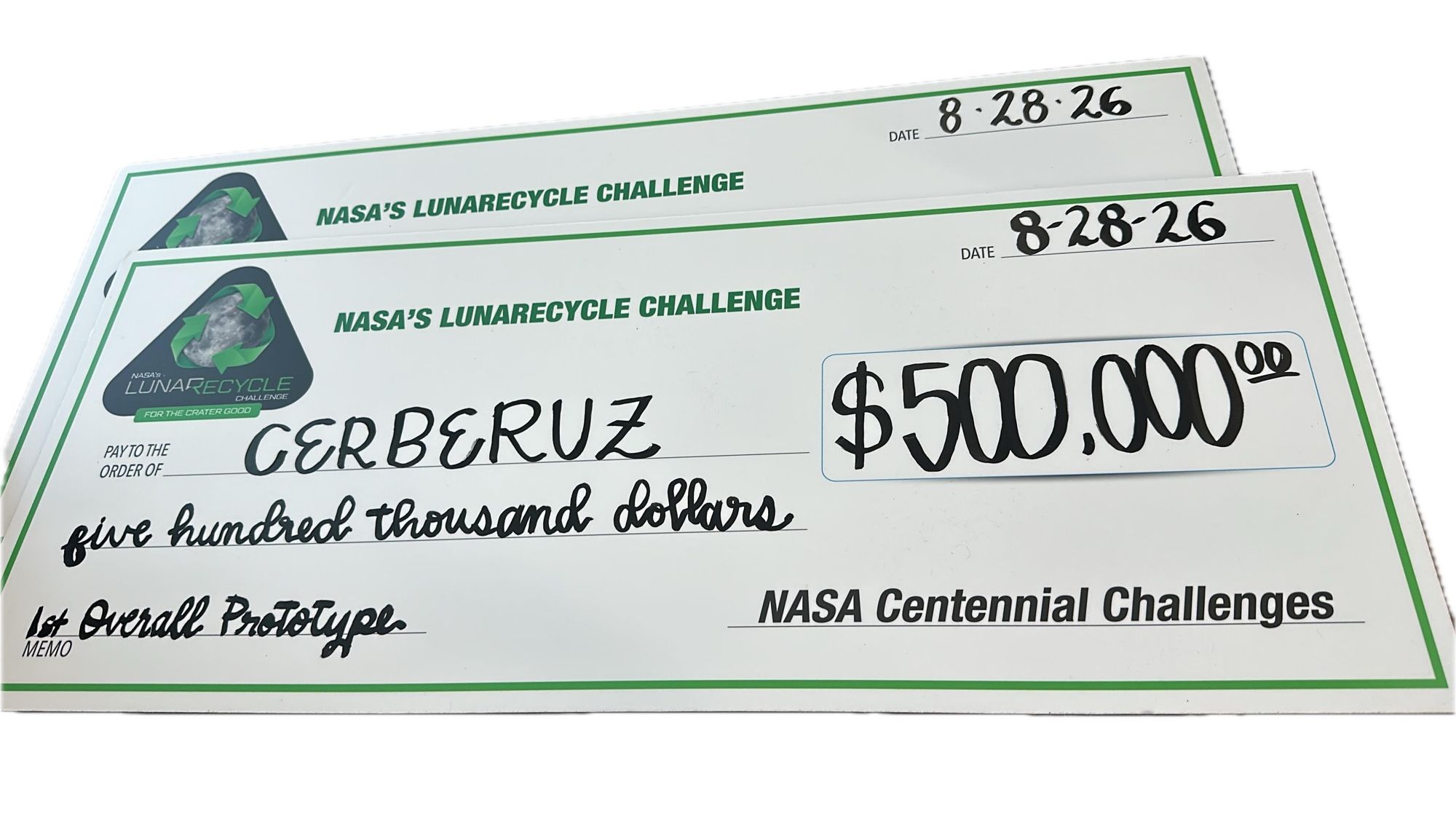
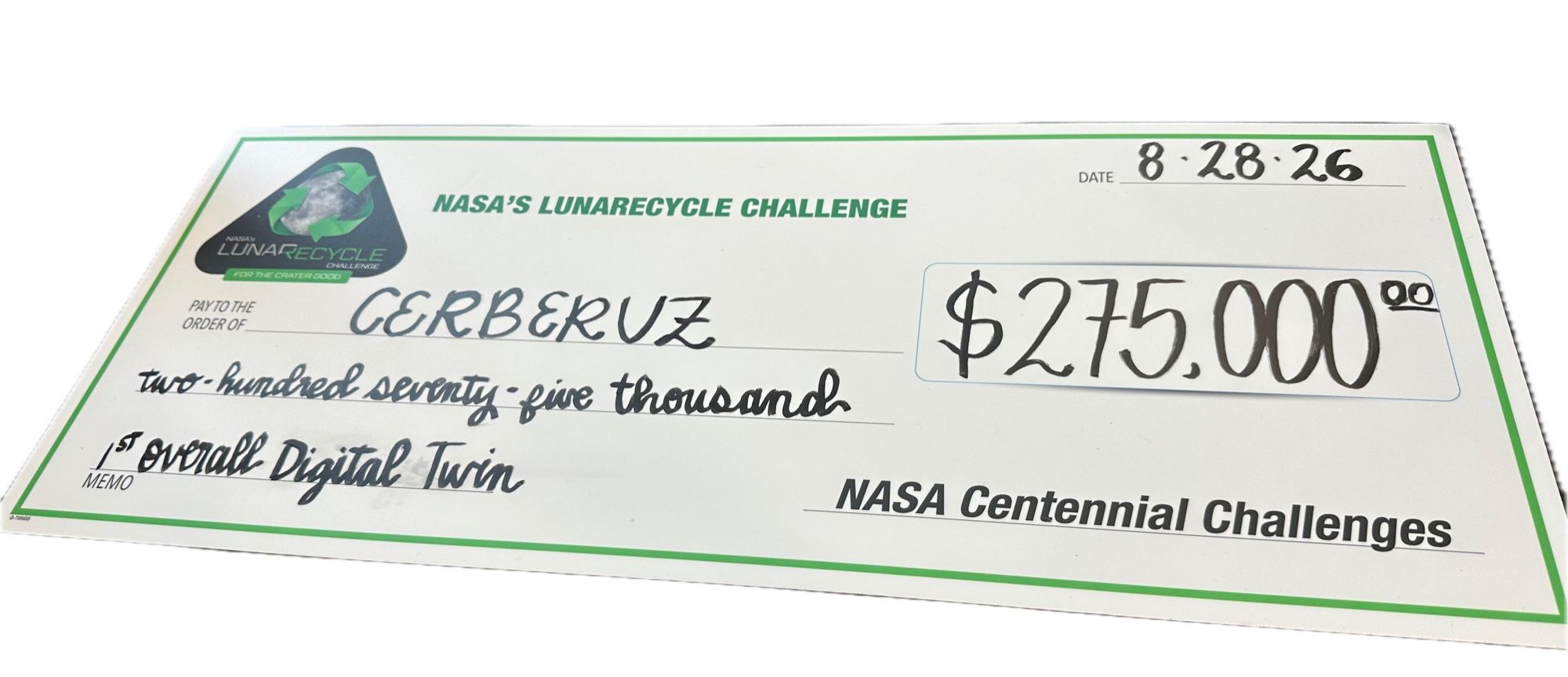
The checks presented on the final day: $500,000 for 1st Overall Prototype and $275,000 for 1st Overall Digital Twin, $775,000 in all, the largest prize any Space Resources Workshop team has brought home. With the Phase 1 and Milestone Round prizes before it, CERBERUZ's collective winnings from the challenge come to $925,000.
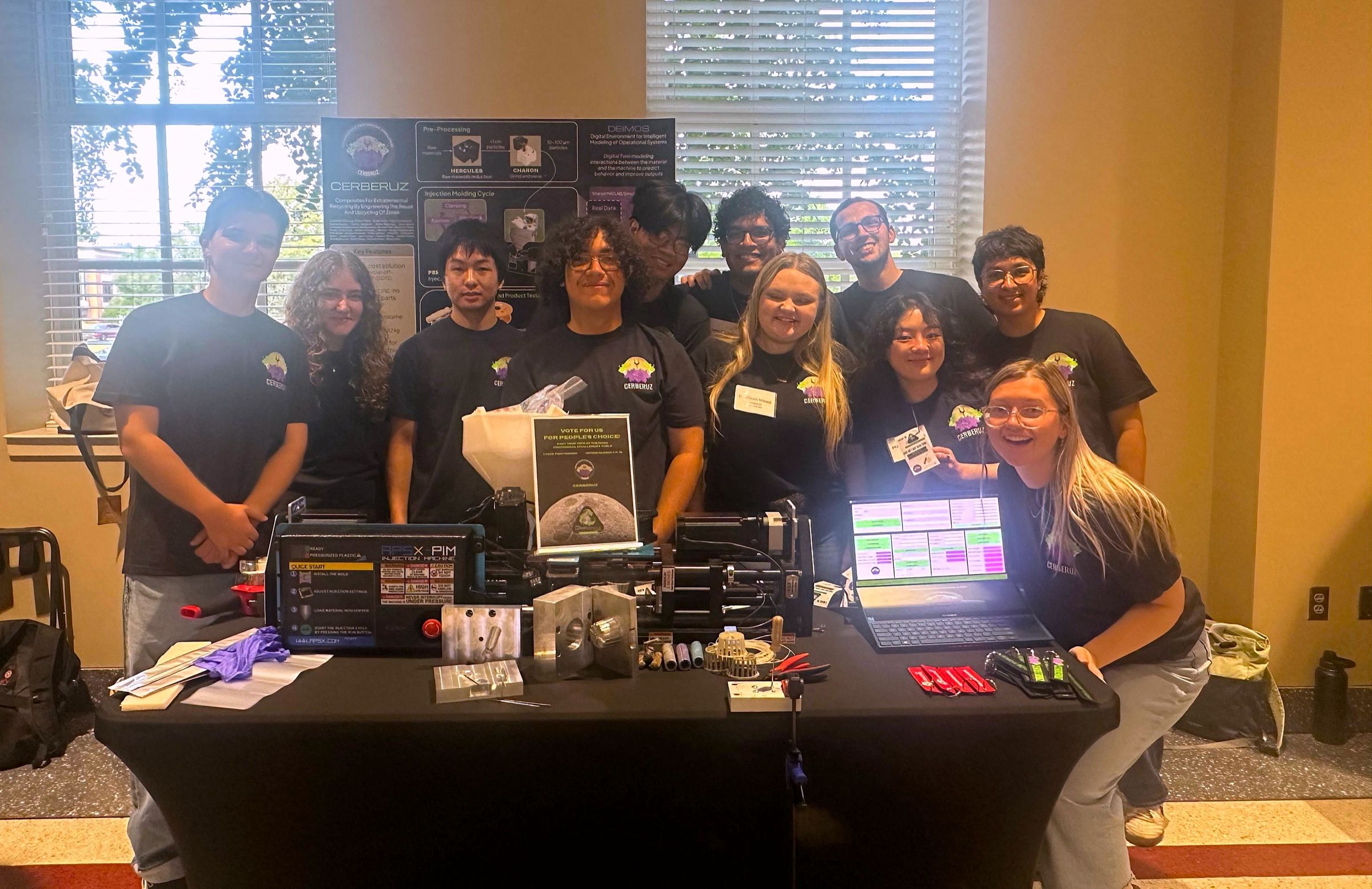
Through the finale week the team ran continuous demonstrations at its table, prototype hardware in front and posters behind, and briefed NASA and university media on the system. (Images: CERBERUZ team.)
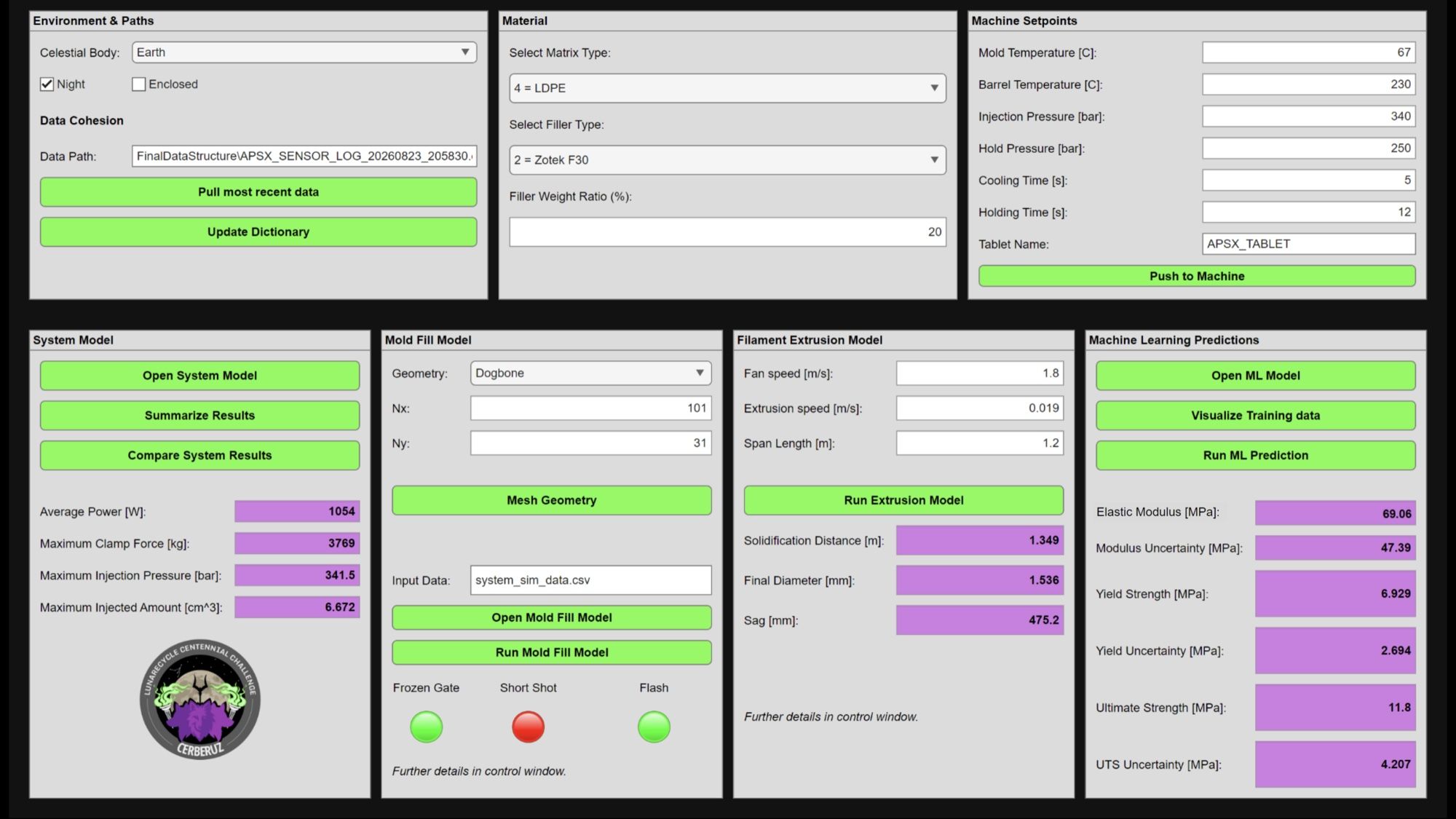
At the finals the demonstration ran 680 grams of the waste stream through one six-hour cycle at 94.3 percent mass efficiency, five materials in, four products out. The other first place went to DEIMOS (Digital Environment for Intelligent Modeling of Operational Systems), the team's digital twin of PERSEPHONE: a MATLAB and Simulink model, validated against production-run data, that tracks the molten material through the machine, updates itself live from the machine's sensors, and predicts mold fill, warpage and shrinkage risk under Earth, Moon and Mars conditions.
The team's Milestone-round video walks through the prototype solution end to end:
Team
The CERBERUZ effort was spearheaded by four MIT graduate co-leads: Lilly Etzenbach and Jose Soto (graduate students, Aeronautics and Astronautics), Lanie McKinney (PhD student, Aeronautics and Astronautics), and Palak B. Patel (PhD candidate, Mechanical Engineering). Across the two phases, twenty-eight more contributors joined from across the Institute. From Aeronautics and Astronautics: Sophie Bergkvist, Ariella Blackman, Seth Burrowes, Alex Chen, Juan Orrego and Jordan Prawira, with graduate student Hillel Dei and PhD students Mollie Johnson and Christopher Kwon. From Mechanical Engineering: Sophia Augier, Andrew Chen, Chris Choe, Natalie Hatzigeorgiu, Intia Ibnah, Avishai Jeselsohn, Uma Kirk, Jessica Meza, Giuliana Pertuz and Adrian Yang. From Electrical Engineering and Computer Science: Brady Cruse and Brandy Romine. From Materials Science and Engineering: Keira Boone and Constantine Bulavenko. From Civil and Environmental Engineering: PhD candidate Jiali Ma. First-years Johnson Cristales, Dustin Wang and Madison Wood, and MIT alumnus Jonatan Fontanez, complete the roster. Prof. Jeffrey Hoffman and I served as faculty advisors.